Brands of Therapy: “Psychosynthesis”

Psychosynthesis: A Psychology with a Soul

Worth reading from off the Web!

This article is a synopsis of the writings by Sydney psychotherapistJodie Gale.

my4seasons

Psychosynthesis is known worldwide as ‘a psychology with a soul’. It integrates the best that western psychology has to offer, along with eastern and western spiritual theories, practices and techniques; such as the art of presence, mindfulness, meditation and visualisation.  Psychosynthesis is a holistic approach and can include an exploration of the physical, emotional, psychological, social, sexual, cultural, ecological and spiritual elements and influences on health and well-being.

Exploring spirituality is linked with better health outcomes

Spirituality in this context is often used to describe the deeper essence of who we are, the innate part of us that continuously calls us towards growth and wholeness. This is the spiritual Self, also known as the deeper or higher Self (capital S). The Self is made up of will and consciousness – it is our life force. When connected to our deeper essence, it provides us with renewed vitality, a way of understanding and finding value, meaning and purpose in life.

Roberto Assagioli MD, the founder of psychosynthesis, was a psychoanalyst and neurologist.  Although heavily influenced by eastern and western spirituality, he was adamant that psychosynthesis would be accepted as a respectable scientific theory.

According to recent empirical research by MU College of Arts & Science, exploring spirituality is linked with better health outcomes. Dan Cohen believes that spirituality not only fosters better mental health but may help our relationships by decreasing self-centeredness and increasing our sense of connectedness and belonging to a larger whole.

The clinical psychology program at Columbia University is currently experimenting with integrating psychotherapy and spirituality in ways rarely seen at a major research university.

Do I need to be ‘spiritual’?

One critique of a spiritual approach in psychotherapy includes a fear that the therapist will not be neutral and may have expectations that we have to be spiritual. In their book, ‘A Psychotherapy of Love’, psychosynthesis authors Firman and Gila write that therapists ‘need to die to their own world in order to love their clients in their worlds.’ This altruistic, empathic, selfless and unconditional regard are the hallmarks of the psychosynthesis therapist. Because of its inclusive nature, psychosynthesis is perfect for people from all walks of life. Many people who do not consider themselves spiritual (including atheists) have transformed their lives throughout psychosynthesis therapy.

A model of growth and transformation for dealing with crises

The therapist holds the concept that within every crisis, something new is seeking to emerge.  The experience of suffering can eventually lead us to growth and transformation. Psychosynthesis author Stephanie Sorrel suggests that we cannot avoid all suffering in life, but through suffering, we can “enter into relationship with the world of soul and the potential richness of its wisdom (2009).” We don’t always have control over what comes our way, but we do have a choice about how we relate and respond to these events. Psychosynthesis therapy can help us find new life direction and a sense of empowerment even after the most unimaginable suffering.

Relationship is at the heart of psychosynthesis

Our relationship with our self is the premise for all further relationships. In neuro-psychosynthesis-psychotherapist Dr Stratford’s recent research, she found that a high therapeutic alliance impacted on brain and body; clients felt safer, anxiety was reduced, they gained insight and processed trauma. The empathic, unconditional love and acceptance experienced in therapy allows us to reconnect with our authentic self.  Psychosynthesis gives us a context of hope for resolving difficulties in all of our relationships.

In psychosynthesis therapy

A psychosynthesis therapist is interested in the potential of human nature rather than diagnosis and equating us with our illnesses. The therapist uses ‘bifocal vision’ to see that we are more than our problems. Psychosynthesis practitioner Diana Whitmore writes that we are perceived “as a Self, a being with a purpose in life and with immense potential for love, intelligence and creativity…also as a personality, an individual made up of a unique blend of physical, emotional and mental characteristics” (2000).

~ Jodie Gale
from: https://www.australiacounselling.com.au/mental-health-articles/therapeutic-approaches/psychosynthesis-psychology-soul/

Thoughts on “Mindfulness”

by Ajahn Sumedho

From off the Web

Meditation and Psychotherapy 

“I was invited to a conference in Gloucestershire not so long ago which was all about dealing with spiritual crises. There were therapists, psychiatrists and counsellors there talking about mindfulness, because this word ‘mindfulness’ seemed to be the main topic of interest, which I thought was very good.

The way to liberate the mind is through mindfulness or awareness, and this is the essence of the Buddha’s teaching; this is the important one.

It isn’t that people in general are never mindful or always heedless and ignorant, but speaking for myself, it never meant anything to me in the past; it wasn’t raised up as anything significant. I would be mindful under certain circumstances, but I didn’t know what mindfulness was; I was just that way because the conditions were there for it. And in life-endangering situations, I would be particularly mindful. People would ask me afterwards, ‘Were you frightened?’ And I would say, ‘No, I was very mindful.’

It wasn’t that I had trained myself to be that way; it was just that I was naturally alert on those occasions; it just happened as part of the life-preservation instinct. We didn’t call it ‘mindfulness’, of course, and it wasn’t appreciated even though it had happened. After developing meditation over the years, however, I began to recognize and understand the power of it rather than just seeing it as a technique or a way to gain some limited state.

Psychotherapy gives a forum for talking about things that you would not perhaps talk about in other circumstances. It can be quite useful for allowing fears to become conscious, especially the darker aspects of the psyche. You can’t talk to just anybody about these things because you need someone who will listen to you without making judgements or giving advice, so having that facility can initially be quite useful as a skillful means.

But if that process becomes addictive, you can get too interested in yourself as a person. In meditation, on the other hand, you don’t find your personality that interesting after a while.”

http://buddhismnow.com/2010/07/01/meditation-psychotherapy/#comment-20555The path of mindfulness is the path of no preferences

The path of mindfulness is the path of no preferences. When we prefer one thing to another, then we concentrate on it: ‘I prefer peace to chaos.’ So, then, in order to have peace, what do we do? We have to go to some place where there is no confusion, become a hermit, go up to the Orkneys, find a cave.

I found a super cave once off the coast of Thailand. It was on a beautiful little island in the Gulf of Siam. And it was my sixth year as a monk. All these Westerners were coming to Wat Pah Pong-Western monks. And they were causing me a lot of sorrow and despair. I thought: ‘I don’t want to teach these people; they’re too much of a problem; they’re too demanding; I want to get as far away from Western monks as possible.’

The previous year I had spent a Rains Retreat with five others. Oh, what a miserable Rains Retreat that was! I thought: ‘I’m not going to put up with that! I didn’t come here to do that; I came here to have peace.’ So I made some excuse to go to Bangkok and from there I found this island. I thought it was perfect. They had caves on the island and little huts on the beaches. It was the perfect set-up for a monk. One could go and get one of those huts and live in it. And then go on alms-round in the village.

The village people were all very friendly, especially to Western monks because to be a Western monk was very unusual. We could depend on having all the food we could possibly eat, and more. It was not a place that was easy to get to, being out in the Gulf of Thailand, and I thought: ‘Oh, they’ll never find me out here, those Western monks; they’ll not find me here.

And then I found a cave, one with a Jongram, and it was beautiful. It had an inner chamber that was completely dark and no sounds could penetrate. I crawled in through a hole and inside there was nothing. I could neither see nor hear anything. So it was ideal for sensory deprivation: ‘Oh, this is exactly what I’ve been looking for; I can practise all these high Jhanic states. I can go in this cave and just practise for hours on end with no kind of sense stimulation.’

I really wanted to see what would happen. But there was this old monk living in this cave who was not sure whether he was going to stay. Anyway, he said I could have the grass hut on the top of the hill. I went up there and looked, and down below was the sea. I thought, ‘Oh, this is also nice because now I can concentrate on the sea, which is tranquillising.’

There was a Thai monk on the island who was a very good friend of mine and he said: ‘Well, if they find you here, there’s an island about fifteen miles further out-they’ll never find you there. There’s a little hut there, and a little village; the people in the village would love to take care of a monk.’ So I was thinking: ‘You know, possibly after the Rains Retreat, I will go out to that further island.’

I really was determined to escape. I wanted peace and I found the Western monks very confusing. They would always ask lots of questions and were so demanding. So I was all set to spend the Rains Retreat in this idyllic situation.

My right foot became severely infected and they had to take me off the island into the local hospital on the mainland. I was very ill. They would not let me go back to the island and I had to spend the Rains Retreat in a monastery near the town.

Sorrow, despair and resentment arose towards this foot-all because I was attached to tranquillity. I wanted to escape the confusion of the world; I really longed to lock myself in a tomb where my senses would not be stimulated, where no demands would be made on me, where I would be left alone, incognito, invisible.

But after that I contemplated my attitude; I contemplated my greed for peace. And I did not seek tranquillity any more.

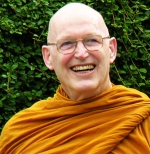
Ajahn Sumedho was ordained as a Buddhist monk in Thailand in 1967 and trained under the guidance of the highly respected Thai teacher, Ajahn Chah. He is now the abbot of Amaravati Buddhist monastery in England.

Ajahn Sumedho

http://buddhismnow.com/2009/10/12/path-of-mindfulness/

More about : http://en.wikipedia.org/wiki/Ajahn_Sumedho