Worth Reading!

Toxic emotions disrupt the workplace, and mindfulness increases your awareness of these destructive patterns, helping you recognize them before they …
Worth Reading!
Toxic emotions disrupt the workplace, and mindfulness increases your awareness of these destructive patterns, helping you recognize them before they …
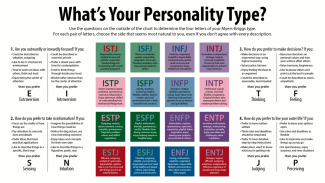 “We all come in different shapes and SIZES. We have our STRENGTHS and weaknesses.
The Theory of Psychological Types was described by Carl Jung in the 1920’s. He theorized that much of the seemingly random variations in peoples behaviors are actually rather systematic and reliable. These basic differences can be viewed as the ways an individual prefers to:
Isabel Briggs Myers studied Jung’s ideas and added her own insights. After 30 years of research and over 5,000 participants, she created a survey that would eventually become the Myers Briggs Type Indicator (MBTI) (MBTI by Isabel Myers). It is the most widely used measure of Psychological Types.
Personality typing is a tool that is particularly helpful in personal growth: Understanding ourselves in a semi-objective way leads to heightened self-esteem.
It’s also a way to understand others: If people differ in what they perceive and in how they reach conclusions, then it is only reasonable for them to differ in their interests, reactions, values, motivations, and skills.
Learning about our Personality Type helps us to understand why certain areas in life come easily to us and others are more of a struggle. Learning about other people’s Personality Types help us to understand the most effective way to communicate with them.
This self-report questionnaire assesses “type preferences” on Extraversion-Introversion (E-I), Sensation-Intuition (S-N), Thinking-Feeling (T-F), and Judgment-Perception (J-P).
According to the MBTI, we all have a primary mode of operating within four categories:
I’ve searched high and low and found these great online tools. The first link is to a good adaptation of the original test (Copyright infringements prohibit the availability of the real one):
 Counseling TidBits