Katie on: “How I Learned To Stop Suffering”
When I was in my early forties, I slept with a loaded gun under my bed. I’d become severely depressed in my thirties, and for almost a decade I spiraled down into paranoia, rage, self-loathing, and thoughts of suicide. I weighed more than two hundred pounds (I’m 5’5″), and for the last two years I was often unable to leave my bedroom.
Then, one morning in February 1986, out of nowhere, I experienced a realization. In an instant, I discovered that when I believed my stressful thoughts, I suffered, but when I questioned them, I didn’t suffer. I also discovered a simple way of questioning stressful thoughts. I call it “The Work.” I found a joy within me that has never disappeared, not for a single moment. That joy is in everyone, always.
Suffering is optional. The only time we suffer is when we believe a thought that argues with reality. When the mind is perfectly clear, what is, is what we want. If you want reality to be different than it is right now, you might as well try to teach a cat to bark. You can try and try, and in the end the cat will look up at you and say, “Meow.” You can spend the rest of your life trying to teach a cat to bark.
If you pay attention, you’ll notice that you’re continually trying to teach cats to bark. “People should be kinder.” “My children should be better behaved.” “My husband (or wife) should agree with me.” “I should be thinner (or prettier or more successful).” These thoughts are ways of wanting reality to be different than it is. If you think that sounds depressing, you’re right.
People new to The Work often say to me, “But it would be disempowering to stop my argument with reality. If I simply accept reality, I’ll become passive. I may even lose the desire to act.” I answer them with a question: “Can you really know that that’s true?” Which is more empowering, “I wish I hadn’t lost my job” or “I lost my job; what can I do now?”
The Work reveals that what you think shouldn’t have happened, should have happened. It should have happened because it did, and no thinking in the world can change it. This doesn’t mean that you condone it or approve of it. It just means that you can see things without resistance and without the confusion of your inner struggle. No one wants their children to get sick, no one wants to be in a car accident; but when these things happen, how can it be helpful to argue with them and think of ourselves as victims of reality? We know better than to do that, yet we do it, because we don’t know how to stop.
I don’t ever want anything to happen except what’s happening. For example, my ninety-year-old mother was dying of pancreatic cancer. I was taking care of her, cooking and cleaning for her, sleeping beside her, living in her apartment twenty-three hours a day. (My husband took me out for a walk every morning.) It was as if her breath was the pulse of my life. I bathed her, I washed her in the most personal places, I medicated her, and I felt such intimacy with her. There was no separation. That’s me over there, dying of cancer, spending my last few days sleeping and watching TV and talking, medicated with the most marvelous pain killing drugs. I am amazed at the beauty and intricacies of her body, my body. And on the last day of her life, as I sat by her bedside, a shift took place in her breathing, and I know: it’s only a matter of minutes now. Our eyes locked, and a few moments later she was gone. I looked more deeply into the eyes that the mind had vacated, the mindless eyes, the eyes of the no-mind, and because I can no longer believe thoughts like “Death is a bad thing” or “I’ve lost her,” I feel only love and gratitude for her. There’s not a trace of sorrow. And in the three years since her death, I’m still waiting for sorrow to happen.
A man sticks a pistol into my stomach, pulls the hammer back, and says, “I’m going to kill you.” I am shocked that he is taking his thoughts so seriously. He doesn’t understand that the thought of killing causes guilt, which can lead to a life of suffering, so I ask him, as kindly as I can, not to do it. I don’t tell him that it’s his suffering I’m thinking of. He says that he has to do it, and I understand; I remember believing that I had to do things in my old life. I thank him for doing the best he can, and I notice that I’m fascinated. Is this how she dies? Is this how the story ends? As the joy continues to fill me, I find it miraculous that the story is still going on. You can never know the ending, even as it ends. I am very moved at the sight of sky, clouds, and moonlit trees. I love that I don’t miss one moment, one breath, of this amazing life. I wait. And wait. And in the end, he doesn’t pull the trigger. He doesn’t do that to himself.
______________________________________
You can also click on the images below.
The Work sheet –
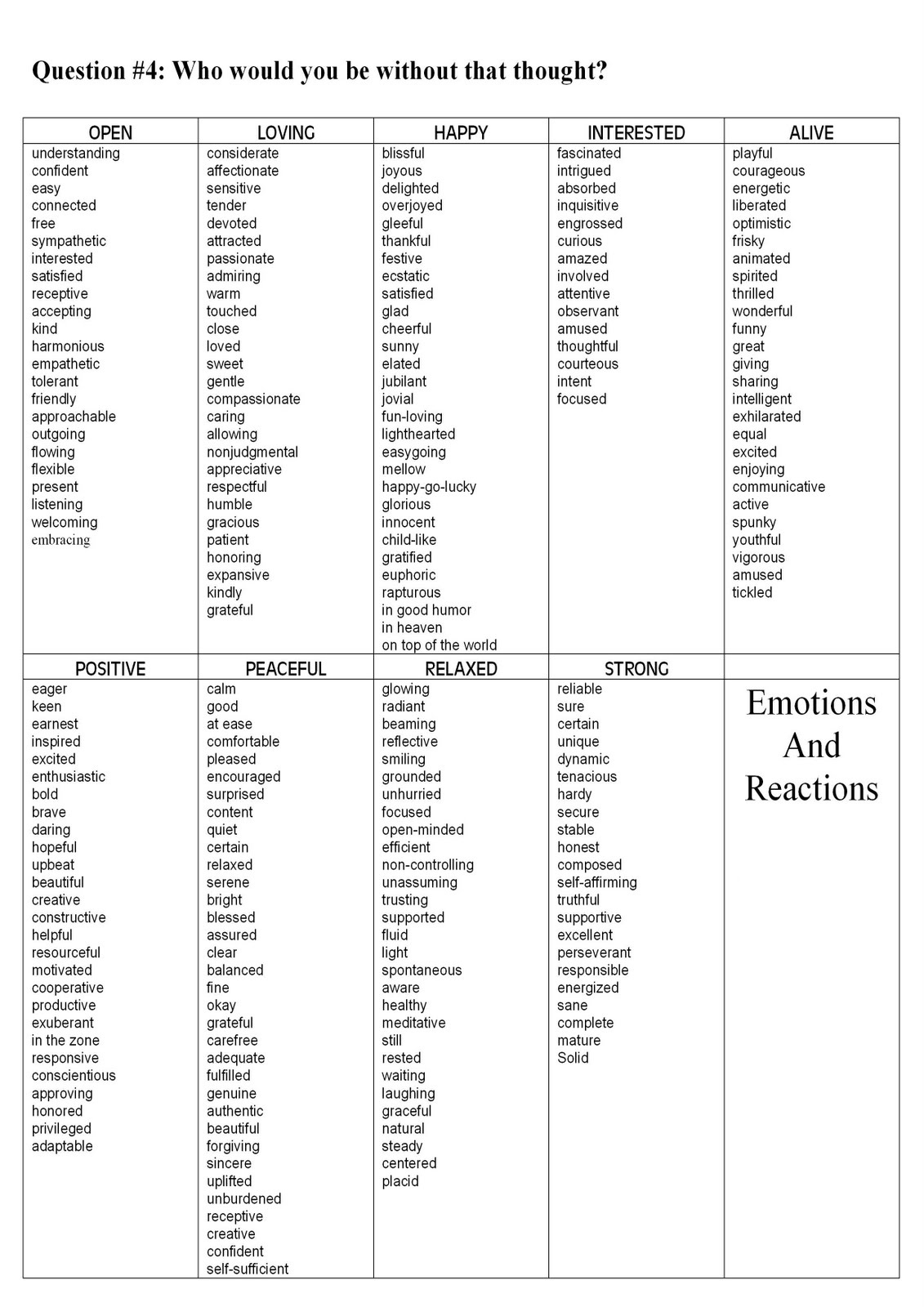
Suggestions to answer Question 3 – How do you react when you believe that thought?




 Counseling TidBits