3 Solutions to Panic Attacks

Panic attacks are NOT uncommon.

Some people experience them once or twice in a lifetime while others have them whenever they’re speaking in public or are preparing for an important phone call. In severe cases, sufferers may feel like they’re going to die.

Anxiety is defined as “fear of the unknown”, and historically, it aides in survival. It’s close relative,  fear,  prepared us to choose fight-or-flight in dangerous situations by heightening our senses and dumping the fine-tuning chemicals into our blood stream, like adrenaline and epinephrine.

Yet today, while still protecting us from genuine danger,  fear and panic somehow morphed into a bunch of barely relatable and dysfunctional afflictions:  panic disorder,  obsessive-compulsive disorder,  phobias, and generalized anxiety disorder.

As your rate of breathing accelerates, you begin to chest-breathe instead of belly breathing (breathing deeply). This causes hyperventilation, where you are blowing off too much carbon dioxide (CO2) . This leads to a rise in blood pH, which in lay-terms, means symptoms like dizziness, weakness, fainting, headache, and tingling in the hands and feet.

SOLUTIONS

1. Focus on deep breathing.

Hyperventilation brings on many sensations, like lightheadedness and tightness of the chest. By learning to tune into your breathing, and then consciously controlling it, you develop a coping skill that you can use to calm yourself down when you begin to feel anxious. If you know how to control your breathing, you are also less likely to create the very sensations that you are afraid of.

2. CO2 Normalizes blood pH.

If you are already experiencing a full-blown panic-attack, breathe into a paper bag.  It will reduce many of the extraneous symptoms of panic and help normalize your breathing by re-balancing your bloods pH.

3. Practice relaxation techniques.

The opposite of a panic-response is a relaxation-response. If you are prone to anxiety attacks,  learn and practice relaxation techniques. When practiced regularly activities such as yoga, meditation, mindfulness, and progressive muscle relaxation, you are strengthening the body’s relaxation response. It also helps you become aware of the difference between bodily sensations that are relaxed versus sensations that indicate dysfunctional tension. Make time for relaxation exercises every day!

**Note: If these techniques do not help, please see a therapist for a deeper evaluation of the causes for your panic. 

Source: The Neurobiology of Panic Attacks

Do Your Behaviors Define Who You Are?

Do Your Behaviors Define Who You Are?  …  Not really.

When I was a camp counselor, various stories were told at the end of mealtime. These stories were meant to stimulate conversations for later, when the kids and their counselor returned to their cabins for the night.
The following story was so powerful that I’ve never forgotten it:

There Once Was a Girl With a Very Bad Temper

So the girl’s father wanted to teach her a lesson. He thought long about WHAT he wanted her to learn (as all good parents will do). Finally, he decided.

He gave her a bag of nails and told her, “Every time you lose your temper I want you to hammer a nail into the wood fence.”

On the first day the girl had driven 25 nails into the fence. “This is kind of fun”, she told her father. “”But by the time I’m done hammering,  I can’t even remember why I was so mad!”

Over the next few weeks, as she began to control her temper, the number of nails she hammered into the fence gradually dwindled.

Finally, the day came when the girl didn’t lose her temper at all. She was so proud of herself; she couldn’t wait to tell her father!

Pleased, her father said, Now pull out one nail for each day that you hold your temper“.

The days passed and the girl was finally able to go back to her father and tell him that she had pulled out all the nails.

Then, gently, the father took his daughter by the hand and led her to the fence.

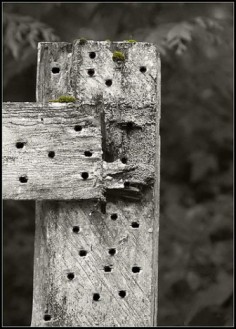
“You have done well”, he smiled. “But look at the all the holes in the fencee. The fence will never be the same.”

The little girl listened carefully as her father continued to speak:

When you say things in anger, you leave scars,  just like these in the fence.

Even if you say you’re sorry, the wound is still there”.

                     ~ * ~

Later, I came to realize why it had special meaning for me.  My anger was used as a defense mechanism to protect me from an insensitive,  critical,  and abandoning parent. I learned, without conscious thought, that anger was safer than tears.   It became so automatic that I didn’t even notice the damage I was causing.

But like so many of our childhood coping skills, I couldn’t even turn it off in circumstances that didn’t involve my family. I came across as mad when I was probably sad or scared instead.

So when I heard this fable, I woke up.  I had to become aware of anger’s purpose for me.  I learned that my defenses were not who I was – they were survival/coping skills.  I had to decide that I didn’t want to be that way anymore.  After all,  I was no longer a child and realistically I didn’t need my mother to survive. So I learned, instead, to cope with the underlying feelings. I taught myself that being sad, confused, or scared, was “okay“.

If anger is expressed without awareness,  it will damage all of your relationships.

Take the time to learn to communicate effectively;  journal to become versed in understanding where  your feelings come from;  and get a book about Assertive Communication.