Cute metaphor – Don’t you think? :)

Life is like a camera. Focus on what’s important. Capture the good times. Develop from the negatives. If things don’t work out, just take another shot. — Unknown

Cute metaphor – Don’t you think? :)
Life is like a camera. Focus on what’s important. Capture the good times. Develop from the negatives. If things don’t work out, just take another shot. — Unknown
I remember reading somewhere that the average person has about 3000 thoughts per minute, along with the corresponding emotions, expectations, and conclusions. I don’t know how they came up with 3000, but lets assume it’s true – That’s a lot of stuff going on! If you want to be clear and congruent in your communications, it’s essential that you slow this process down. You have to learn how to check in with yourself.
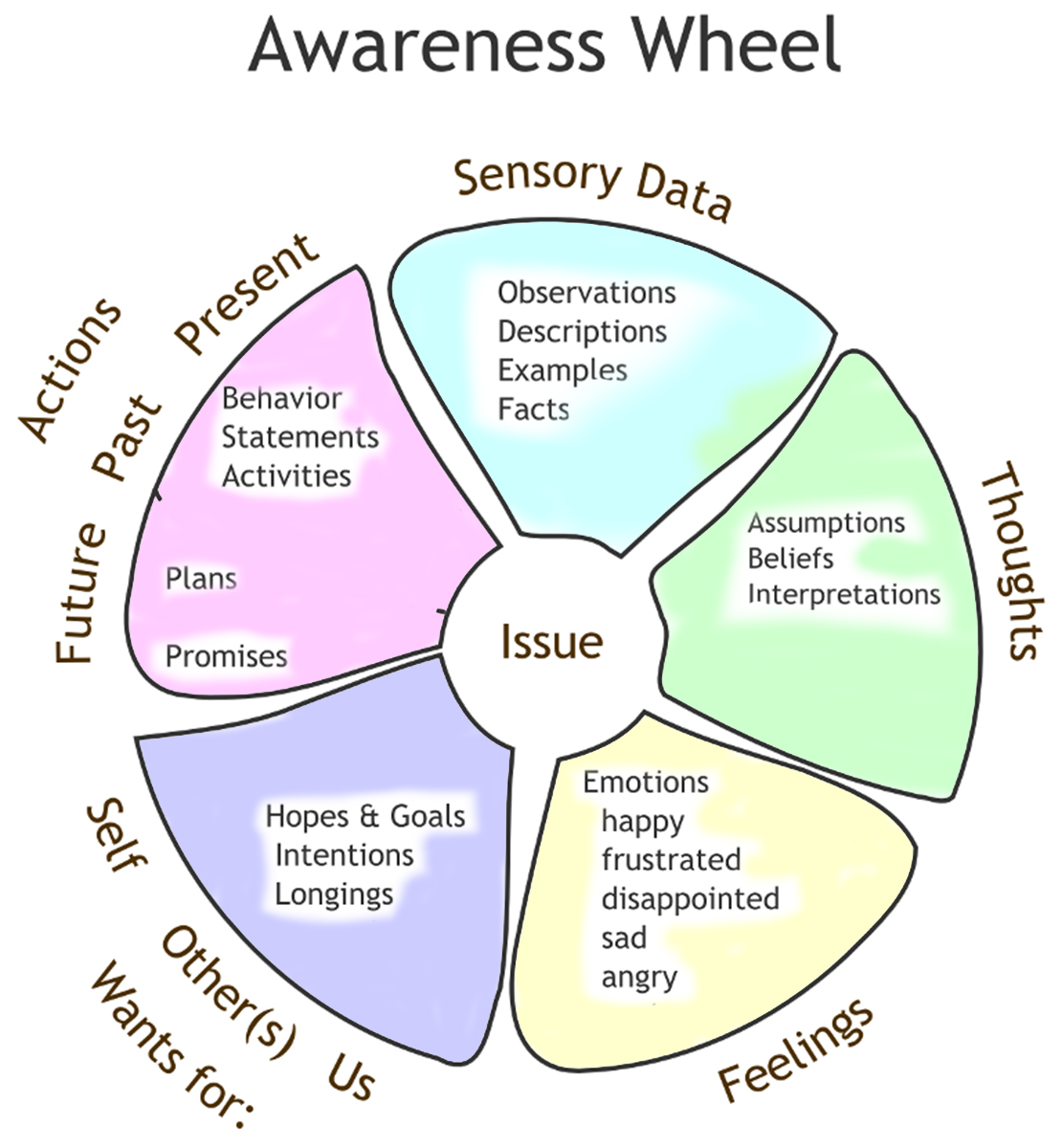
One of the tools I use with my clients in therapy is called The Awareness Wheel. Once mastered, it helps the user understand their experiences (awareness), and, if desired, communicate clearly to someone else.
Each experience can be broken down into the following five categories:

A common problem in relationships that often occurs is the result of confusing FACTS with interpretations about what is happening. Our interpretations generate emotions, and we can be caught up in our anger or hurt because our interpretation is different from our partners. The model helps you to clarify interpretations and emotions by going back to the original sensory data (what you saw, heard or felt) and checking each other’s interpretations. You may or may not get to agreement on the meaning of what you witnessed, but it’s helpful to know what each of you is thinking and perceiving.
Speaking as though we know the “other’s” intentions, feelings, or thoughts is offensive. By using “I” statements, we show that we are speaking responsibly about something we should be an authority about – ourselves!
Reflective listening consists of slowing the conversation down, while assuring your focus is on being a good listener and not your defense! After a sentence or two, you, the Listener, repeat back in your own words what you think your partner is saying. You then ask if you heard them accurately and completely. You keep trying this until your partner says, “Yes, I feel understood.” Then you switch, and you say a few sentences to your partner, and they repeat what they heard back to you.
For example:
“When _(Facts)_ I thought (Thought/Belief) and I felt (Emotion) . What I’d like is (Request/Want). What do you think?” (invites sharing)
Or:
“I felt _(Emotion) when you _(Facts)_ because (Thought/Belief) , and I want _(Request/Want)_. What do you think?”
For example:
Let’s call my clients Joe and Jess.
Jess comes home after a frustrating, but productive day at work. She gets out of her car, and notices, again, the dead spots on the lawn (sensory data). She scowls (feelings- anger) and thinks (thoughts), “How many times do I have to ask Joe to fix the sprinklers!!!” (Wants and actions).
She enters the house and hears a football anouncer blaring from the TV (sensory data). She roles her eyes (feelings: sad/disappointed) and thinks, “He’s not even with the kids. It’s like I have THREE children instead of two.”
 Jess goes into the kitchen to find her mother feeding the kids their dinner, and is so thankful that she at least has her mother! Jess thinks she wants a divorce.
Because Jess has worked with me for a while, she decides to not act on all these conclusions, but goes to her room to journal about first.
After summarizing the last 5 minutes (as written above), she asks herself :
“ok, so WHATS the issue?”.
I don’t feel supported; and I’d like a more equal partnership.
She practices her approach in the journal first, remembering the advice :”How can I say this in a way that Joe is more likely to HEAR me?”
Can I talk to you about some things? (Invites participation).
Ok. This is just my perception, ok? When I got home today, I noticed the dead grass again, then I walked in to find you watching TV while mom was feeding our kids. (SENSORY DATA). And I Thought to myself ‘Joe isn’t taking our talks seriously!’ … because – I mean – how many times have I asked you to help me take care of the house better? How many times have I told you that the kids need more time with you (prior Wants and Actions)?? Naturally, I am incredibly frustrated (Feelings)! I’m seriously getting to the point of giving up (Want), and I may want a divorce.(future Action).
 Counseling TidBits